School groups and families picked up judging sheets at the welcome table and then explored the exhibits, assessing presenters on communication, clarity, engagement, and scientific content. Students evaluated how effectively each researcher explained their ideas, from the research question and methods to results and poster design. Visitors moved from poster to poster, asking questions, sharing insights, and practicing how to evaluate scientific presentations.
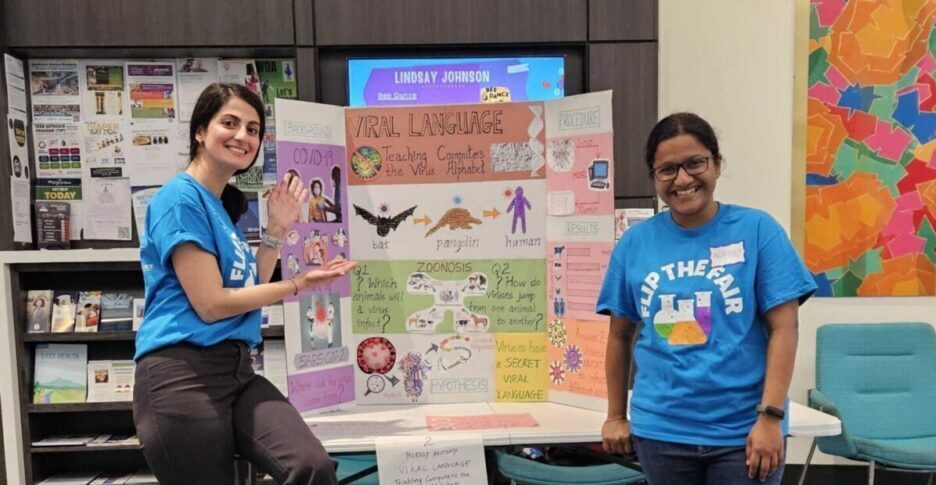
Hannah Brown (Postdoc, Virology) and Blessy Antony (Ph.D. student, Computer Science) participated in the fourth annual Flip the Fair held at the Melrose Branch Library in Roanoke, Virginia. Hannah and Blessy were judged by approximately 450 elementary school children from six local public schools.
In the following quotes, the Hannah and Blessy explain how this unique fair impacted their research and inspired changes in their science communication as a result.
Hannah Brown
“I presented my current work, which includes using laboratory -made “mini organs” to grow viruses that are otherwise difficult to grow in the lab.”
“I really enjoyed interacting with the students. They were full of curiosity and asked thoughtful, often unexpected questions, some of which helped me see my research from new angles or think about how to explain complex concepts more simply.”
“I was honored to receive the Curious Questioner Award, which recognized presenters who effectively explained the “why” behind their research and the importance and motivation driving the work. I have always enjoyed communicating my science to different audiences, and this experience reminded me how powerful it is for scientists to communicate in an accessible and relatable way.”
“I hope to take part in more outreach like this and continue finding creative ways to make science approachable, engaging, and fun for all audiences.”
Blessy Antony
“I thoroughly enjoyed participating in Flip the Fair for the second consecutive year. Participating in Flip the Fair, helped me pause and reflect on the “why,” “how,” and “what” of my work. The workshop organized by the Center for Communicating Science at Virginia Tech helped us prepare for the event.”
“Participating in Flip the Fair challenged me to swap my usual “thinking” hat for a “communicating” one. We had to communicate our research at the level of an elementary student, simplify the jargon at multiple levels, use creativity and artistic skills to present the research, design fun activities for the school children, and to top it all, we had under five minutes to communicate the importance and impact of the research.”
“I presented my research on identifying potential hosts of known and novel viruses using computational models under the topic “Viral Language: Teaching Computers the Viral Alphabet,” and I received some thoughtful questions and feedback. One student asked, “If bats are awake at night and pangolins sleep then, how did the pangolin get SARS-CoV-2 from the bat?” The student’s curiosity helped me realize how I often take many facts for granted. Another asked, “Can a virus infect a train or airplane?” and it made me think about what makes living organisms uniquely susceptible to infection.”
Hannah and Blessy both agreed that the students’ enthusiasm reminded them why they enjoy being scientists in the first place. Flip the Fair encourages scientists to re-focus on “why” their research matters, “how” it connects to real-world problems, and “what” broader impacts it may have.