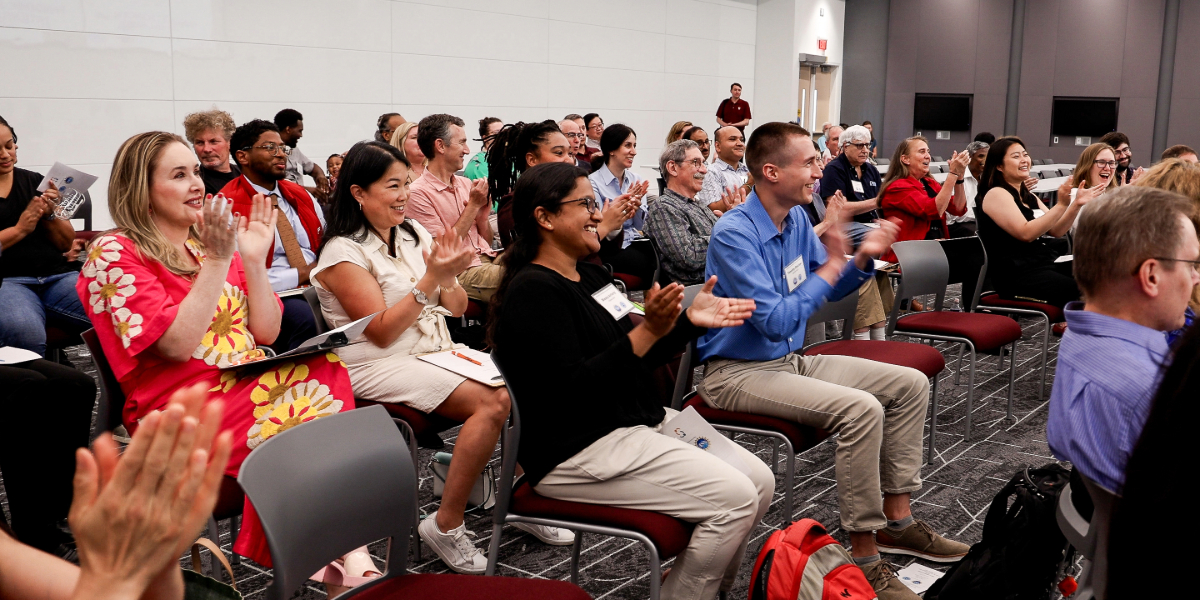
The U.S. National Science Foundation COMPASS Center held its inaugural annual meeting July 31–Aug. 1, 2025, at Virginia Tech’s Academic Building One in Alexandria, Virginia. The event brought together researchers, communicators, and collaborators from across the country to celebrate completion and progress of year one and chart the future of pandemic science. Through two days of presentations, workshops, and collaborative dialogue, the COMPASS team deepened its connections and reaffirmed its commitment to interdisciplinary innovation.
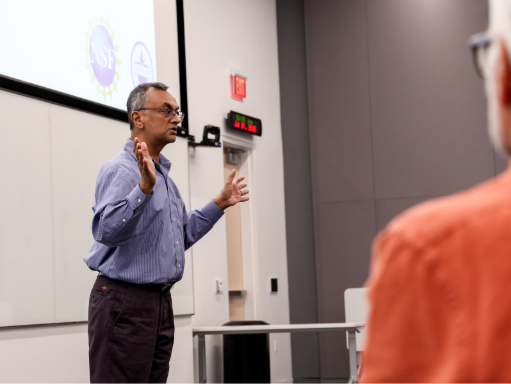
Director T. M. Murali opened the meeting by delivering a reflective message on the Center initiatives as well as the origin of COMPASS. Murali highlighted the major achievements from year one, including establishing COMPASS as a vibrant center for interdisciplinary research and defining a forward-looking, inspiring mission and vision. He described how the Center is an interdisciplinary powerhouse with partners from across the country, including Virginia Tech, Cornell University, Meharry Medical College, University of Michigan, and Wake Forest University, with Northern Arizona University, set to join the team in 2028.
After the welcome address from Murali, the team participated in team building exercises developed and presented by faculty from the Virginia Tech Center for Communicating Science (CCS). These activities offered an opportunity for attendees to meet one another and provided insights into how the group might connect, communicate, and collaborate. Following lunch, the focus shifted to the foundations of effective collaboration. Participants were guided through the principles of team science, emphasizing the importance of intentional structures and shared understanding in interdisciplinary work.
The afternoon of July 31 focused on research, the heart of the COMPASS center. The leads from the four COMPASS thrusts — Jump, Replicate, Persist, and Empower — along with students, post-doctoral fellows, and research associates presented the goals and more detailed updates from year one and shared ideas for the future. These presentations led to thoughtful questions and discussions from the audience. Team members gained a deeper appreciation and understanding of the Center’s mission. The NSF COMPASS Center Evaluator closed the afternoon sessions with a presentation about the Center’s evaluation processes.
Day one concluded with the first annual Pandemic Science in a Nutshell Games. Through the Nutshell Games, researchers demonstrated the power of storytelling. The energy and inspiration sparked by the Nutshell Games carried participants into day two.
The next session brought thrust teams together into breakout groups. Team members explored long-term and short-term goals and strategies to meet their research plans. Each group laid out the groundwork for a successful year two.
In the final session, the Executive Committee and the External Advisory Board held a closed session meeting as did members of the Empower Thrust with the Community Advisory Board to reflect on the Center’s first year and plan future activities. Discussions emphasized strengthening communication within COMPASS and beyond, expanding digital outreach, building trust in public health messaging by centering community concerns and engaging youth as science ambassadors through education, literacy and prevention efforts. In parallel, a workshop for early career scientists focused on collaboration and communication skills.
To end the meeting, Murali expressed gratitude to all participants, acknowledging the time and energy they invested in both reflection and future planning. He encouraged the team to continue pushing boundaries in pandemic research.
Following the formal conclusion of the meeting, two pilot Community Dialogues were conducted to test preliminary formats and feedback surveys. One dialogue focused on organoid science and ethics with trainees. The second focused on wastewater surveillance with CAB and Empower members as ‘mock’ participants.
The two-days of activities highlighted that communication and collaboration are not just skills, but practices to be cultivated. With the right environment, support, intention, and colleagues, the COMPASS community continues to strengthen its ability to listen, share our work more clearly, and to collaborate towards a healthier, more resilient future.